What Is Occlusion in Dentistry? Your Bite, Your Health, and Why It Matters More Than You Think
If you have ever been told by a dentist that your bite is “off”, that you have a bad bite, or that something about the way your teeth come together is causing a problem elsewhere in your mouth — you were being told something about your occlusion.
For most patients, occlusion is a completely unfamiliar term. Yet the way your teeth meet when you close your mouth is one of the most clinically significant factors in your long-term oral health. It affects how your teeth wear, whether your restorations last, how your jaw joints function, and whether you experience headaches, jaw pain or unexplained tooth sensitivity.
This guide explains what occlusion actually means, why it matters clinically, what happens when it is not right, and how modern dentistry assesses and corrects it.
At Spa Dental Clinic in Droitwich Spa, led by Dr Murtaza Kaderbhai GDC: 103185 and Dr Nazia Alyas GDC: 103370, occlusal assessment is a standard part of every thorough dental check-up — because understanding how the teeth work together is inseparable from understanding the health of the whole mouth.
What Is Occlusion in Dentistry?
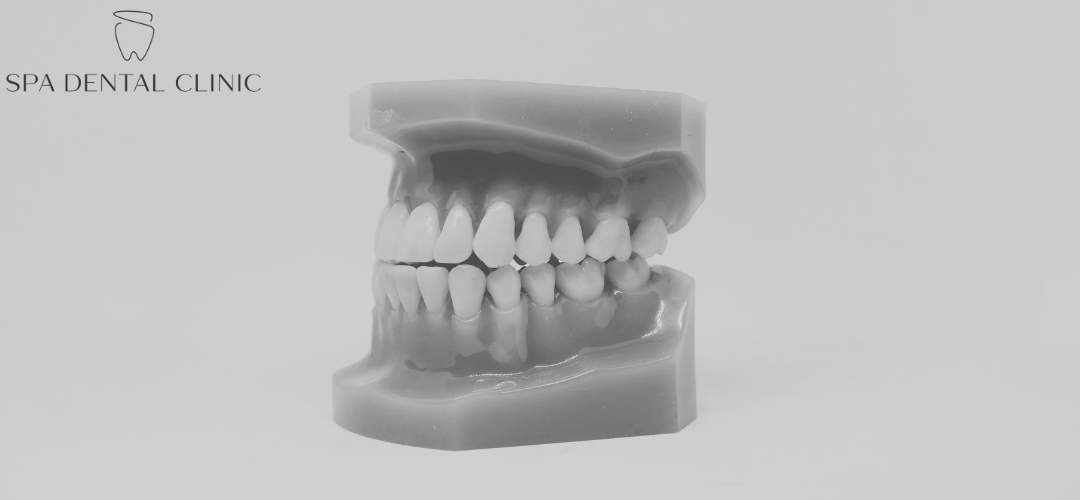
Occlusion in dentistry refers to the contact relationship between the upper (maxillary) and lower (mandibular) teeth when the jaw closes. In its most literal sense, dental occlusion simply means the way the teeth bite together — but in clinical practice, it encompasses a much richer picture than that simple definition suggests.
A complete understanding of teeth occlusion includes:
– The position of each tooth within its arch and in relation to the opposing arch
– The pattern of contacts made between upper and lower teeth during full closure
– The way the teeth slide and separate as the jaw moves through chewing, speaking and swallowing
– The guidance provided by specific teeth during lateral (side-to-side) and protrusive (forward) jaw movements
– The relationship between the teeth, the jaw joints (temporomandibular joints, or TMJs) and the muscles that move the jaw
This is why dentistry occlusion is considered a foundational topic in dental education and clinical practice. Every restoration placed in the mouth — every filling, crown, veneer, bridge or implant — alters the occlusal scheme in some way. Every orthodontic treatment changes tooth positions and therefore changes how the teeth contact. Getting occlusion right is not just about comfort: it is about the long-term survival of the teeth, the restorations and the jaw joints themselves.
The Components of a Healthy Occlusion
To understand what can go wrong with occlusion, it helps to understand what a healthy, well-functioning bite looks like.
Centric Relation and Maximum Intercuspation
There are two key reference positions in occlusal assessment.
Centric relation (CR) is the position of the mandible (lower jaw) relative to the skull when the jaw joints (TMJs) are in their most stable, physiological position — ideally with the condylar heads seated in the most superior-anterior position in the joint space. This is a reproducible, joint-based reference point that does not depend on tooth contact.
Maximum intercuspation (MI) — also called centric occlusion — is the position of maximum tooth contact, where the upper and lower teeth fit together with the most cusp-to-fossa contacts. This is where the teeth actually close habitually.
In an ideal occlusion, CR and MI coincide — meaning that when the jaw closes comfortably into maximum tooth contact, the jaw joints are simultaneously in their most stable position. When there is a discrepancy — where the teeth guide the jaw into a position away from where the joints would naturally seat — the resulting muscle activity and joint strain can drive a range of problems over time.
Anterior Guidance
As the jaw moves forward and sideways from the maximum intercuspation position, the front teeth and canines play a critical guidance role. Specifically:
Canine guidance is a scheme in which the canine teeth on each side bear the contact load during lateral jaw movements, causing the back teeth to separate slightly. This protects the molars — which are not designed to absorb heavy lateral forces — from those forces during chewing movements.
Group function is an alternative scheme in which several teeth on the working side share the lateral contact load. This is also considered acceptable, though canine guidance is generally associated with lower rates of tooth wear and restorative failure in the back teeth.
Incisal guidance describes the relationship of the upper and lower front teeth during protrusive (forward) jaw movements. The front teeth guide the jaw as it moves forward, determining how quickly the back teeth separate and thus how those teeth are protected during protrusive function.
The Curve of Spee and the Curve of Wilson
The natural arrangement of the teeth in the dental arch is not flat — it follows gentle three-dimensional curves. The curve of Spee describes the anteroposterior (front-to-back) curvature of the arch when viewed from the side; the curve of Wilson describes the mediolateral (inner-to-outer) curvature when viewed from the front. These curves are not random — they reflect the functional geometry of jaw movement and determine how the tooth cusps interdigitate harmoniously during chewing.
Types of Dental Occlusion
Teeth occlusion is classified clinically using a system developed by Edward Angle in the late 19th century, based on the relationship of the upper and lower first molars.
Class I Occlusion: The Ideal
In a Class I molar relationship, the mesiobuccal cusp of the upper first molar occludes in the buccal groove of the lower first molar. This is considered the ideal molar relationship, and when combined with properly aligned individual teeth and good anterior guidance, it represents a well-balanced, functional bite.
Class I occlusion does not mean the bite is necessarily perfect — there can still be crowding, spacing or individual tooth alignment problems within a Class I molar relationship. But the foundational relationship between the arches is correct.
Class II Occlusion: The Overjet or Retrognathic Bite
In a Class II relationship, the lower first molar is positioned too far back relative to the upper — meaning the upper teeth are in front of the lower teeth to a greater degree than ideal. This is the relationship commonly associated with a prominent upper jaw, increased overjet (horizontal distance between upper and lower front teeth) and what people often describe as an “overbite” (though strictly, overbite refers to vertical overlap, not horizontal projection).
Class II occlusion is divided into two divisions:
– Class II Division 1: Increased overjet with normally inclined upper incisors
– Class II Division 2: Reduced overjet with retroclined (angled backwards) upper central incisors and often increased vertical overlap (deep bite)
Class III Occlusion: The Underbite or Prognathic Bite
In a Class III relationship, the lower first molar is positioned too far forward — the lower front teeth sit in front of the upper front teeth when the jaw is closed. This is the relationship associated with a prominent lower jaw and what is commonly described as an underbite.
Class III occlusion can range from a mild tendency (edge-to-edge incisors) to a severe skeletal discrepancy requiring combined orthodontic and orthognathic (jaw surgery) treatment.
What Is Malocclusion and What Does It Cause?
Malocclusion — literally “bad bite” — is any deviation from ideal occlusal relationships that has clinical consequences. Understanding what is occlusion in dentistry clinically requires understanding the spectrum of malocclusion and the problems it drives.
Tooth Wear
When teeth contact in ways they are not designed to, the enamel pays the price. Excessive wear is one of the most visible consequences of poor occlusion. Teeth that bear lateral forces they should not receive — because the canine guidance is absent, for example — develop flattened, worn occlusal surfaces. The wear pattern across the dental arch gives a skilled clinician important information about how the bite is functioning.
Tooth Fracture and Restoration Failure
Restorations placed in a mouth with an unmanaged occlusal problem are subject to forces they were not designed to absorb. A crown placed on a tooth that takes excessive lateral load is more likely to fracture — both the ceramic and, in more severe cases, the tooth structure beneath it. Fillings that repeatedly fracture or debond, veneers that chip, and bridges that fail repeatedly are often telling the dentist something about the occlusion rather than about the material.
This is one of the reasons occlusal assessment is part of treatment planning before any significant dental check-up or restorative work — placing work into a faulty occlusal environment without addressing the underlying problem is setting that work up to fail prematurely.
Bruxism and Tooth Grinding
Bruxism — the habit of grinding or clenching the teeth, typically during sleep — is closely associated with occlusal problems, though the relationship is complex and bidirectional. Occlusal interferences and a discrepancy between centric relation and maximum intercuspation can drive bruxing behaviour as the jaw attempts to find a comfortable position. Bruxism then causes progressive tooth wear, jaw muscle hypertrophy (enlargement), temporomandibular joint strain and headaches.
Managing bruxism without considering the occlusal environment is treating the symptom while leaving the cause.
Temporomandibular Disorder (TMD)
The temporomandibular joints are the jaw joints that allow the mouth to open, close and move laterally. These joints, their associated muscles (the masseters, temporalis and pterygoids) and the teeth form an integrated system — change one part of the system and the others are affected.
Poor occlusion can strain the TMJs over time, contributing to temporomandibular disorder (TMD) — a spectrum of conditions characterised by jaw joint pain, clicking or locking of the jaw, limited mouth opening, and referred pain to the ears, temples and neck. These symptoms are often initially misattributed to ear problems or tension headaches, which is why a thorough occlusal assessment at a dental check-up is important when these symptoms are present.
Gum Disease Risk
Occlusal forces also affect the health of the periodontium — the gum and bone supporting the teeth. When excessive or abnormal forces act on a tooth, the periodontal ligament responds with widening (visible on X-rays as a widened ligament space), and over time this can accelerate bone loss around the affected teeth, particularly in patients who already have some degree of gum disease. Managing both the gum disease and the occlusal overload is necessary for long-term periodontal stability. Regular dental hygienist appointments alongside occlusal assessment address both dimensions of this problem.
Headaches and Facial Pain
The muscles that power the jaw are large, powerful structures that attach across a significant portion of the skull and face. When these muscles are chronically overactive — because the jaw is constantly searching for a comfortable occlusal position, or because bruxism is loading them — patients experience muscle-origin headaches, facial pain and neck tension. These headaches are often described as tension-type and can be remarkably persistent and debilitating.
Patients who have been treated for headaches medically without resolution are sometimes found, on dental assessment, to have a significant occlusal component to their symptoms that had not previously been considered.
How Is Occlusion Assessed in Clinical Practice?
A thorough occlusal assessment involves several elements:
Clinical history: Symptoms such as jaw clicking, limited opening, headaches, tooth sensitivity, awareness of grinding or clenching, and the history of previous restorations provide important context.
Visual and tactile examination: The wear patterns on the teeth are examined — where the most significant wear is, whether it is localised or generalised, and what it suggests about jaw movement patterns. The muscle bulk of the masseter and temporalis muscles is assessed, and any asymmetry in muscle size or tenderness on palpation is noted.
Articulating paper: Thin marking paper placed between the upper and lower teeth and used during various jaw movements records exactly which teeth are making contact and when. This identifies premature contacts (teeth touching earlier than they should in the closure path), occlusal interferences (contacts that occur during lateral movements in areas that should be free of contact), and the distribution of load across the arch.
Radiographic assessment: X-rays can show widening of the periodontal ligament space (indicating occlusal overload), bone loss patterns, root resorption and the condition of the temporomandibular joint.
Study models: In more complex cases, accurate stone or digital models of the teeth are mounted on an articulator — a mechanical device that reproduces jaw movements — allowing the occlusion to be analysed outside the mouth, at leisure, and treatment to be planned precisely before any clinical work begins.
Occlusion and Orthodontic Treatment
One of the most direct ways dentistry occlusion is addressed clinically is through orthodontic treatment — repositioning the teeth to improve both their alignment and the way they meet.
Invisalign — of which Spa Dental Clinic is the number one Diamond Provider in Worcestershire — moves teeth through a series of custom clear aligners, each applying precise, planned forces to specific teeth. Invisalign is not simply a cosmetic tool for straightening visible teeth: it is a clinically sophisticated orthodontic system capable of addressing many categories of malocclusion, including crowding, spacing, overbites, underbites, crossbites and open bites.
When orthodontic treatment is planned with occlusion in mind from the outset — not just achieving straight teeth but achieving teeth that come together well — the result is both aesthetically better and functionally more stable. Teeth that are correctly aligned distribute occlusal forces evenly, are easier to clean (reducing gum disease risk), and are less likely to develop the wear patterns associated with poor occlusal relationships.
At Spa Dental Clinic, Dr Murtaza Kaderbhai and Dr Nazia Alyas take an integrated approach to Invisalign treatment planning — assessing the occlusal outcome as carefully as the aesthetic result.
Occlusion and Dental Restorations
Every restoration placed in the mouth changes the occlusal scheme in some way. A filling that is even slightly too high — sitting proud of the surrounding tooth surface — will be the first tooth to contact when the jaw closes, receiving forces that the surrounding structure was designed to share. That contact, known as a premature contact or high spot, causes the tooth to ache and, over time, can cause the restoration to fracture or the tooth to develop problems.
This is why dentists check the bite after every filling, crown or other restoration — the marking paper test after placement is not routine box-ticking but a genuine clinical necessity. A properly adjusted restoration that integrates correctly into the occlusal scheme lasts significantly longer than one that does not.
For more extensive restorations — multiple crowns, full mouth rehabilitation, implant-supported prostheses — occlusal planning is a major component of treatment design. The materials, the angles of the tooth surfaces, the guidance scheme, the centric stops — all of these are planned deliberately to create a restoration that is both beautiful and biomechanically sound.
The Bottom Line
What is occlusion in dentistry? It is the relationship between the upper and lower teeth when they meet — and it is one of the most clinically significant factors in long-term oral health. Teeth occlusion affects how teeth wear, how restorations perform, how the jaw joints function, and whether patients experience headaches, facial pain and muscle problems that often do not look like dental problems at first glance.
Dentistry occlusion is assessed at every thorough clinical examination and should be a consideration in every treatment plan. At Spa Dental Clinic in Droitwich Spa, Dr Murtaza Kaderbhai GDC: 103185 and Dr Nazia Alyas GDC: 103370 bring this clinical rigour to every dental check-up and treatment plan — from routine restorations and hygienist appointments to Invisalign and beyond.
Disclaimer
The information in this article is intended for general educational guidance only and does not constitute personalised dental or medical advice. For concerns about your bite or oral health, please book an appointment with a qualified dental professional for a proper clinical assessment.
Spa Dental Clinic is a private dental practice at 47 Blackfriars Ave, Droitwich WR9 8RT, led by Dr Murtaza Kaderbhai GDC: 103185 and Dr Nazia Alyas GDC: 103370. We are the number one Diamond Invisalign Provider in Worcestershire, offering Invisalign, dental check-ups, dental hygiene appointments, dental implants, composite bonding, porcelain veneers, teeth whitening, dental crowns, smile makeovers and emergency appointments.