Professional teeth whitening How it works, what it can achieve, and what nobody tells you
You have probably tried a whitening toothpaste. Perhaps strips, or one of the home kits. The results were underwhelming, the sensitivity was real, and the before-and-after photos you had seen online bore no resemblance to what happened to your teeth.
The gap between those products and professional teeth whitening is not a marketing distinction. It is a clinical one. The concentration of active ingredient that can legally be used by a dental professional in the UK is significantly higher than anything available to the public, and the way the treatment is designed and delivered produces results that are genuinely different in degree.
This guide covers what professional teeth whitening actually involves, the science behind why it works (and why it works better than over-the-counter options), who is and is not a good candidate, how Zoom in-surgery whitening compares to custom tray whitening at home, and how to make results last as long as possible.
At Spa Dental Clinic in Droitwich Spa, Worcestershire, led by Dr Murtaza Kaderbhai GDC: 103185 and Dr Nazia Alyas GDC: 103370, professional teeth whitening is one of the most requested cosmetic treatments. The same clinical attention that makes Spa Dental the number one Diamond Invisalign Provider in Worcestershire underpins every whitening case. Here is what you need to know.
Why professional whitening produces results that home products cannot
The active ingredient in all peroxide-based whitening products is the same: hydrogen peroxide, or carbamide peroxide (which breaks down to release hydrogen peroxide). The chemistry does not change between a dentist-prescribed product and a supermarket strip. What changes is the concentration.
Under UK regulations, non-prescription products available to the public are limited to 0.1% hydrogen peroxide. Products prescribed and applied by a dental professional can legally contain up to 6% hydrogen peroxide for home use (in custom trays) and higher concentrations for in-surgery application. This is not a marginal difference. The concentration directly determines how many chromophore molecules (the compounds responsible for tooth colour) the peroxide can oxidise in a given session, and therefore how significantly the tooth colour changes.
The mechanism works like this: hydrogen peroxide penetrates the enamel surface and reaches the dentine beneath, where most tooth discolouration resides. The peroxide molecules react with large, light-absorbing chromophore molecules, breaking the chemical bonds that give them their colour. The resulting smaller molecules absorb less light and reflect more, which the eye perceives as a whiter tooth.
This penetration and oxidation process takes time and sufficient peroxide concentration to be clinically meaningful. At 0.1%, the reaction is so limited that the change in most patients is barely perceptible. At the concentrations used in professional treatment, the change is visible, measurable and lasting.
In-surgery whitening versus custom tray whitening: which produces better results
Both approaches use the same chemical process. The practical differences are in speed, intensity, convenience and long-term management.
In-surgery whitening: Zoom and similar systems
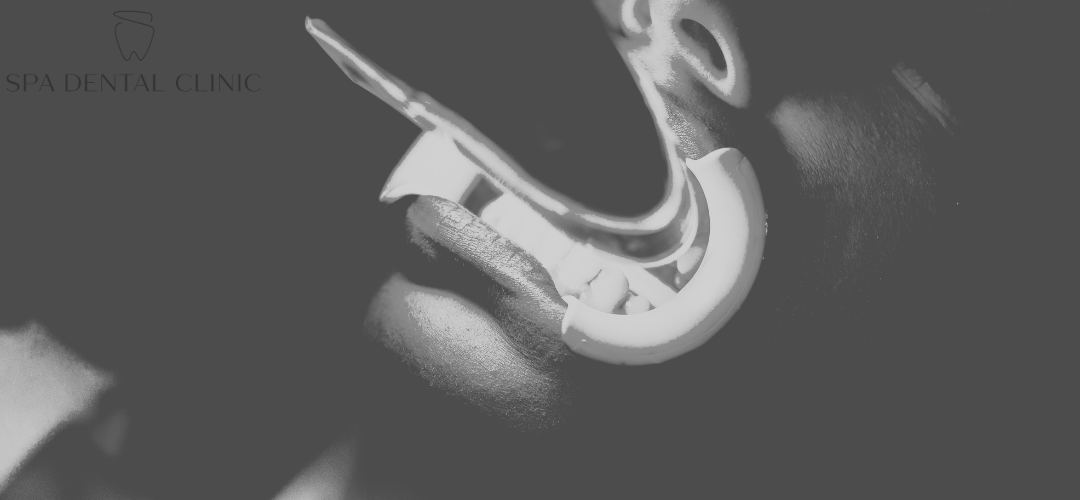
Zoom teeth whitening is one of the most widely used in-surgery whitening systems globally. A high-concentration hydrogen peroxide gel is applied directly to the tooth surface, and a specially designed blue LED light is used to accelerate the activation of the whitening gel. The light increases the temperature of the gel slightly, which speeds the oxidative reaction without damaging the tooth.
A standard Zoom whitening appointment involves three to four rounds of gel application and light activation, each lasting approximately 15 minutes. By the end of the appointment, most patients see a significant shade improvement, commonly between six and ten shades lighter.
The advantages of in-surgery whitening are speed (dramatic results in a single appointment), intensity (the concentration and light activation produce a result that takes weeks to achieve with take-home trays), and the immediate visible transformation.
The considerations: sensitivity following in-surgery whitening can be more pronounced than with take-home trays, because the treatment is more intense. This typically resolves within 24 to 48 hours. The initial result immediately post-treatment is also partly due to dehydration of the enamel, which adds a degree of whiteness that settles slightly over the following week as the enamel rehydrates. The settled result is the accurate representation of the final outcome.
Custom take-home tray whitening
Custom tray whitening is the alternative professional approach: precise impressions or digital scans of the teeth are used to fabricate closely fitting trays, through which a lower-concentration whitening gel is applied at home, typically overnight or for a few hours daily.
The advantages are gradual, controlled colour change with less sensitivity, the ability to whiten precisely to a target shade, and the long-term convenience of using the same trays for maintenance or top-ups with additional gel.
Results develop over two to four weeks of consistent use and tend to be more colour-stable over time than the initial result from in-surgery whitening, partly because the change happens more gradually and the enamel has more time to remineralise between sessions.
The most effective combination
The combination of a single Zoom in-surgery session followed by custom take-home trays for maintenance is widely regarded as the most effective protocol: the in-surgery session produces the immediate dramatic change, and the take-home trays allow the patient to reach their optimal shade and maintain it long-term.
Who is a good candidate for professional teeth whitening
Professional whitening is safe and effective for the majority of adults with healthy teeth and gums. That said, specific factors need to be assessed before treatment proceeds.
Suitable candidates include:
Those with extrinsic staining from coffee, tea, red wine, tobacco or dietary pigments, where the discolouration is in the enamel or outer dentine and the peroxide can reach it effectively. Age-related yellowing, where the dentine has darkened naturally over decades, also responds very well to professional whitening.
Factors that affect suitability or outcomes:
Existing restorations such as crowns, veneers, bridges or tooth-coloured fillings on the front teeth do not respond to whitening. The ceramic and composite materials that restorations are made from are not affected by peroxide. This means that if whitening is planned alongside cosmetic restorations, the sequence matters: always whiten first, allow the shade to stabilise, then match any new restorations to the whitened shade.
Sensitivity: patients with significant existing sensitivity benefit from a pre-treatment period using desensitising toothpaste and, in some cases, from using desensitising gel in the whitening trays between sessions.
Tooth and gum health: whitening should not be carried out on teeth with active decay, cracked enamel, or on patients with untreated gum disease. This is one of the reasons a dental check-up before whitening is clinically essential, not just a procedural formality.
Intrinsic discolouration: certain types of discolouration originate within the tooth structure itself, including tetracycline antibiotic staining, fluorosis, and developmental defects. These respond variably to whitening, and in many cases the improvement is limited. A dental check-up prior to whitening allows a realistic assessment of what is achievable for a specific patient’s specific discolouration pattern.
Whitening is not recommended for:
Pregnant or breastfeeding patients, as a precautionary measure given the absence of studies on the effects of whitening compounds during pregnancy. Patients under 18, where the pulp chambers are proportionally larger and the risk of sensitivity is higher. Patients with known allergy to peroxide compounds.
The step before whitening that most people skip: the hygienist appointment
This is the most commonly overlooked element of the whitening process, and it is clinically significant.
Whitening gel works on the natural tooth surface. When calculus (hardened plaque deposits), surface staining from coffee and tea, or a layer of plaque film covers the enamel, the gel cannot penetrate those surfaces effectively. The result is uneven whitening, with areas beneath deposits remaining discoloured while the exposed enamel lightens.
A dental hygienist appointment before whitening removes all surface deposits and staining, polishes the enamel surface, and ensures the whitening gel has clean, direct contact with every part of the tooth. The improvement in whitening result from this single preparatory step is meaningful: the same gel, the same duration, produces a more consistent and more dramatic outcome on professionally cleaned enamel than on deposits-covered surfaces.
Professional cleaning also removes existing surface staining that was contributing to the yellow appearance of the teeth. Some of the brightening effect that patients attribute entirely to the whitening gel is actually the clean tooth surface now visible beneath where staining used to be. The hygienist appointment and the whitening treatment together produce better results than either alone.
How long does professional whitening last
The honest answer is: it depends on your lifestyle and maintenance habits, but the result is not permanent.
Teeth naturally re-stain over time because the enamel surface continues to accumulate chromogens from food, drink and other sources. The rate of re-staining varies significantly between individuals based on diet, the natural porosity of their enamel, and whether tobacco is a factor.
Typical estimates for the maintained duration of professional whitening results are one to three years, with significant variation either side. Patients who drink large quantities of coffee, tea or red wine without rinsing afterwards will see faster re-staining. Patients who are careful about the frequency of contact between pigmented drinks and their teeth, and who use maintenance gel in their custom trays every few months, can often maintain their results considerably longer.
Periodic top-up sessions with Zoom whitening or the take-home trays extend the effective duration of the original result.
After whitening: what to avoid in the first 48 hours
The 48-hour period immediately following whitening, sometimes called the “white diet” period, is when re-staining risk is highest. This is because the whitening process temporarily increases the porosity of the enamel surface, making it more susceptible to picking up pigment from foods and drinks.
During this window, the guidance is to avoid:
– Coffee, tea, red wine, dark berry juices, cola, tomato sauce, soy sauce, curry, beetroot, dark chocolate and any other food or drink with significant colouring potential.
– Tobacco products, which stain through both direct surface contact and systemic exposure.
After the 48-hour window, normal diet resumes with the understanding that habitual consumption of heavily pigmented drinks will gradually re-stain the teeth over months.
Professional whitening alongside Invisalign
Combining Invisalign treatment with professional whitening is one of the most popular cosmetic dentistry sequences, and with good reason. Invisalign aligns the teeth, and whitening then addresses the colour. The combination produces a comprehensive aesthetic improvement that neither treatment achieves alone.
At Spa Dental Clinic, as Worcestershire’s number one Diamond Invisalign Provider, this combination is planned as a coordinated sequence. Whitening is typically carried out after Invisalign treatment is complete, using the retainer trays as the vehicle for take-home whitening gel where the fit permits, or with dedicated custom whitening trays. The Invisalign retainers designed after treatment are sometimes suitable for use with whitening gel, which reduces both the cost and the number of impressions required.
The Zoom in-surgery whitening appointment is also available as a standalone session at the end of Invisalign treatment for patients who want an immediate transformation in a single visit, before moving to retainer wear.
Safety: professional whitening versus over-the-counter products
Professional whitening is widely studied and has an established safety record across decades of use. The concentrations used in clinical practice have been evaluated in the peer-reviewed literature for effects on enamel, pulp and soft tissue.
At therapeutic concentrations with appropriate technique, professional whitening does not permanently damage enamel. Studies examining enamel microhardness and surface structure after professional whitening show no clinically significant alteration. The temporary sensitivity that many patients experience reflects peroxide reaching the pulp and causing a reversible inflammatory response, not structural tooth damage, and it resolves without intervention in the days following treatment.
Over-the-counter products, restricted to 0.1% peroxide, produce minimal chemical effects on the tooth surface. The whitening effect marketed on these products relies primarily on physical abrasion (from polishing agents) or on the slightly brightening effect of removing the most superficial surface film. Neither mechanism changes tooth colour in the way peroxide oxidation does.
The safety risk with over-the-counter products is not typically chemical: it is the risk of using whitening products on teeth with undetected decay, cracks or other conditions that need clinical assessment. This is precisely why professional whitening begins with a dental check-up at Spa Dental Clinic, which establishes that the teeth and gums are in a suitable condition before any whitening begins.
Bottom line
Professional teeth whitening produces genuinely different results from anything available over the counter, because the concentrations used are clinically meaningful and the treatment is delivered on clean, assessed teeth after appropriate preparation.
The sequence that produces the best results is: dental check-up to confirm suitability, hygienist appointment to clean and prepare the enamel surface, then whitening. In-surgery Zoom whitening for immediate results, or custom take-home trays for a more gradual approach, or a combination of both for the best of each.
At Spa Dental Clinic in Droitwich Spa, Dr Murtaza Kaderbhai GDC: 103185 and Dr Nazia Alyas GDC: 103370 assess every whitening patient individually, provide the appropriate preparatory care, and plan the treatment to achieve the result that is realistic for each patient’s specific teeth, lifestyle and starting shade.
Disclaimer
The information in this article is intended for general educational guidance only and does not constitute personalised dental advice. For a proper assessment of your suitability for professional teeth whitening, please book an appointment with a qualified dental professional.
Spa Dental Clinic is a private dental practice at 47 Blackfriars Ave, Droitwich WR9 8RT, Worcestershire’s number one Diamond Invisalign Provider, led by Dr Murtaza Kaderbhai GDC: 103185 and Dr Nazia Alyas GDC: 103370. We offer Zoom teeth whitening, dental hygienist appointments, dental check-ups, Invisalign, composite bonding, porcelain veneers, dental crowns, dental implants, smile makeovers and emergency appointments.